Changning taps national science talent program to boost Shanghai Silicon Alley 发布时间:2025-11-28 信息来源:上海长宁
On the morning of November 19, a symposium on the cooperative partnership between the Foundation for the Development of Science and Technology in China and Changning District was held. The symposium aimed to deepen collaboration between the two sides, leveraging the foundation's resource advantages to help Changning District gather innovation factors, optimize industrial layout, enhance development capabilities, and continuously inject strong momentum into the construction of Shanghai Silicon Alley. Song Jun, Party Committee secretary and chairman of the foundation, Zhang Wei, secretary-general of the foundation, and Liu Ping, deputy secretary of the District Party Committee and district director, attended the meeting.
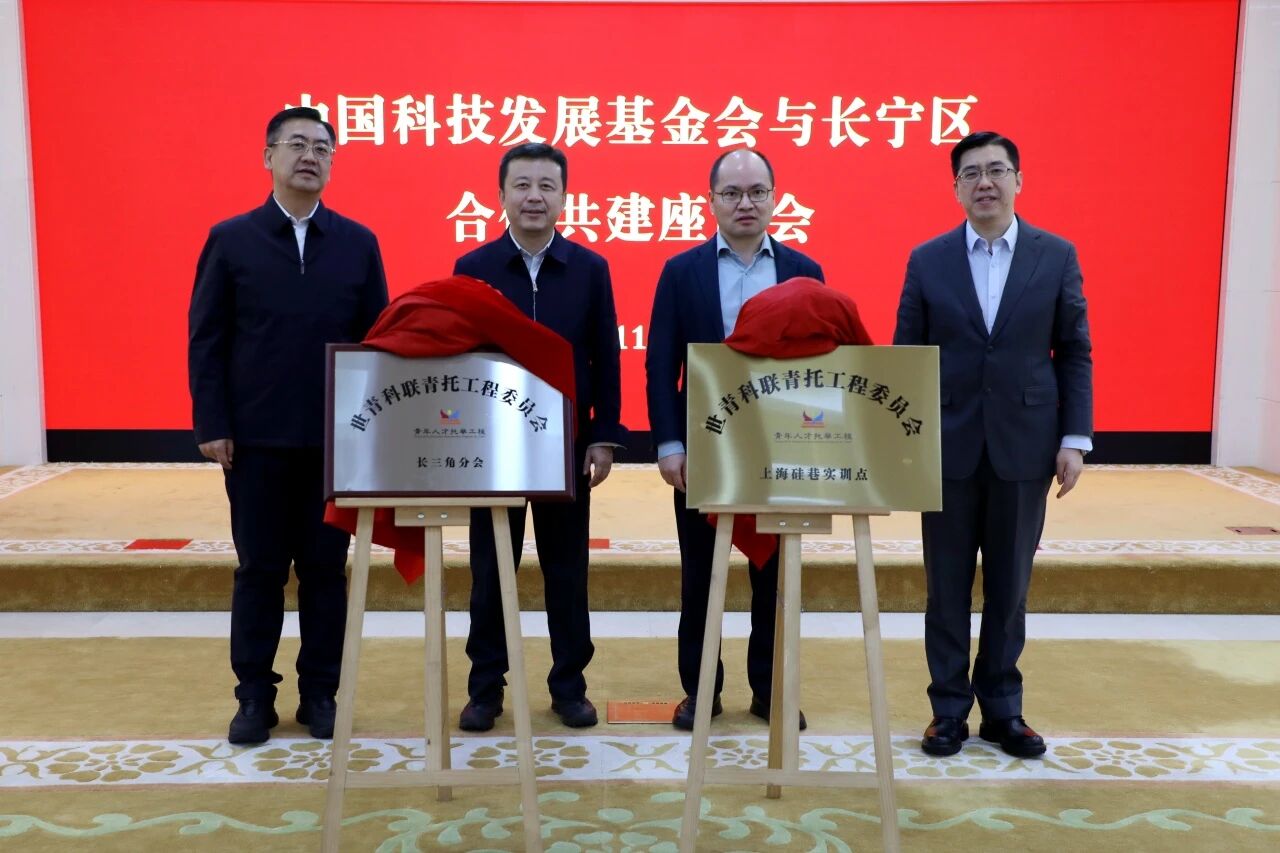
The Young Elite Scientists Sponsorship Program Committee of the World Association of Young Scientists signed a memorandum of cooperation with the Changning District Science and Technology Commission, clarifying the partnership and key collaborative areas. According to the agreement, the two sides will strengthen mutual trust and cooperation on the basis of voluntariness, equality, and integrity. Changning District will support the association's development in terms of space, industrial growth, and supporting services, while the association will fully leverage its role as a bridge to promote the deep integration of Changning's key industries with young scientific research forces. On site, the Yangtze River Delta Branch of the Young Elite Scientists Sponsorship Program Committee and the Shanghai Silicon Alley Training Base of the Young Elite Scientists Sponsorship Program Committee were officially unveiled, marking the transition of the cooperation from strategic consensus to substantive implementation.
Song extended a warm congratulations on the official establishment of the Yangtze River Delta Branch of the Young Elite Scientists Sponsorship Program Committee and expressed his best wishes for the high-quality integrated development of the Yangtze River Delta and the achievement of high-level technological self-reliance and strength in the new era. He stated that the signing of the cooperation agreement between the Foundation for the Development of Science and Technology in China and the Changning District Science and Technology Commission, and the establishment of the Yangtze River Delta Branch in Shanghai Silicon Alley, is not only an important measure to implement the national strategy for the integrated development of the Yangtze River Delta but also a strategic consensus between the foundation and Changning District to complement each other's advantages and collaborate on talent cultivation. He emphasized that the cooperation between the foundation and Changning District should focus on talent cultivation, strengthening the foundation for growth; activating the innovation ecosystem, building efficient matching platforms; and leveraging the fertile ground of Silicon Alley to create international innovation carriers. Through practical measures, the cooperation will be deepened and solidified, injecting strong momentum into the high-quality development of regional science and technology.
At the meeting, Liu and Zhang delivered speeches respectively. Liu pointed out that as a central urban area of an international metropolis, Changning actively implements the "Sci-Tech China" initiative, fully leverages its locational advantages and resource endowment, seizes the opportunity of "science and innovation returning to the urban area," and continuously strives for breakthroughs in industrial cultivation, talent services, and institutional innovation. Shanghai Silicon Alley has become a shining landmark of Changning District, gradually evolving into the core carrier of technological innovation and an important engine for regional industrial upgrading and economic transformation. In advancing the construction of Shanghai Silicon Alley, Changning will focus on creating urban innovation spaces, promoting gradual urban renewal through the integration of production, living, and ecology, and upgrading old factories and idle spaces into high-quality innovation carriers; enhancing innovation source functions, continuously supporting close cooperation between enterprises and research institutions, tackling key technologies, and accelerating the construction of the Digital Silicon Alley Incubator; and optimizing services for scientific and technological talent, enhancing brand projects such as the Hongqiao One-Stop Service Center for Overseas Talent, increasing the supply of talent apartments, and cultivating talent in new tracks such as the low-altitude economy and industrial internet, thereby promoting mutual empowerment between talent and industry. He expressed the hope that the Foundation for the Development of Science and Technology in China would provide forward-looking, innovative, and actionable strategic suggestions for the development of Shanghai Silicon Alley and, through multi-channel and multi-form cooperation, empower Changning District in areas such as talent attraction and cultivation, enterprise incubation, project implementation, and professional service upgrading.
Zhang introduced the Foundation for the Development of Science and Technology in China and the Young Elite Scientists Sponsorship Program. The foundation was established in 1988 under the personal initiative of Qian Xuesen, then president of the China Association for Science and Technology. After nearly 40 years of development, it has gathered resources from all sides and pooled strengths from all quarters, committed to carrying out and supporting public welfare undertakings related to scientific and technological innovation and popular science, and promoting the prosperity and development of scientific and technological endeavors. The Young Elite Scientists Sponsorship Program is a national youth talent cultivation program initiated by the China Association for Science and Technology, aimed at addressing the structural shortcomings in supporting young scientific and technological talent and nurturing young scientific and technological forces with outstanding innovation capabilities and development potential. Since its launch in 2015, the project has selected and cultivated over 5,000 young scientific and technological talents, receiving widespread recognition and praise from all sectors of society.
Subsequently, Zhao Xiaoguang, deputy secretary-general of the Foundation for the Development of Science and Technology in China, delivered a thematic sharing on "Empowering Changning through Industrialization of Scientific Research, Jointly Building a New Benchmark for the Innovation Ecosystem." He said that the industrialization of scientific research is the core engine for completing the innovation value closed loop, with industry-academia-research collaboration, capital empowerment, and policy guidance as its three pillars. Changning's advantages in location as a hub, industrial foundation, fertile policy environment, and talent concentration "precisely match" the needs of scientific research industrialization, making it the optimal scenario for cooperation. In the future, the two sides will primarily focus on jointly building innovation platforms, cultivating industrial clusters, and connecting talent resources, creating a benign ecosystem where "technology is transformed, enterprises grow, and the region develops," achieving mutual benefit and win-win outcomes.
The symposium also invited two professionals supported by the Young Elite Scientists Sponsorship Program of the ninth session of the China Association for Science and Technologyy—Zhang Jie, researcher at the Y-Lab and Yang Jielong, associate professor at Jiangnan Universityy—and representatives from two council members of the Foundation for the Development of Science and Technology in China—Huang Ying, chairman of Huitong Energy, and Tan Sichen, deputy general manager of Huakang Century Clean Technology—to engage in exchange and discussion. The guests shared practical experiences based on their respective research fields and company business development, focusing on topics such as platforms for the growth of young scientific and technological talent, academic innovation and industrial implementation, and the industrialization of scientific research, providing diverse perspectives and practical suggestions for deepening the cooperative partnership between the Foundation for the Development of Science and Technology in China and Changning District.
Deputy District Director Zhao Yongzun, and Deputy Secretaries-General of the Foundation for the Development of Science and Technology in China Li Yang and Zhao Xiaoguang attended the meeting.