Tianshan Tea City becomes new hotspot for international tourists 发布时间:2026-05-29 信息来源:上海长宁
As China continues to expand its visa-free “circle of friends,” Shanghai, the “first stop for inbound tourism,” has seen a large influx of international visitors. Recently, not only landmarks like the Bund, Yuyuan Garden and the Oriental Pearl Tower have drawn huge crowds of foreign tourists, but Changning’s Tianshan Tea City has also quietly gained popularity as a new must-visit destination for travelers seeking an in-depth experience of Chinese tea culture.
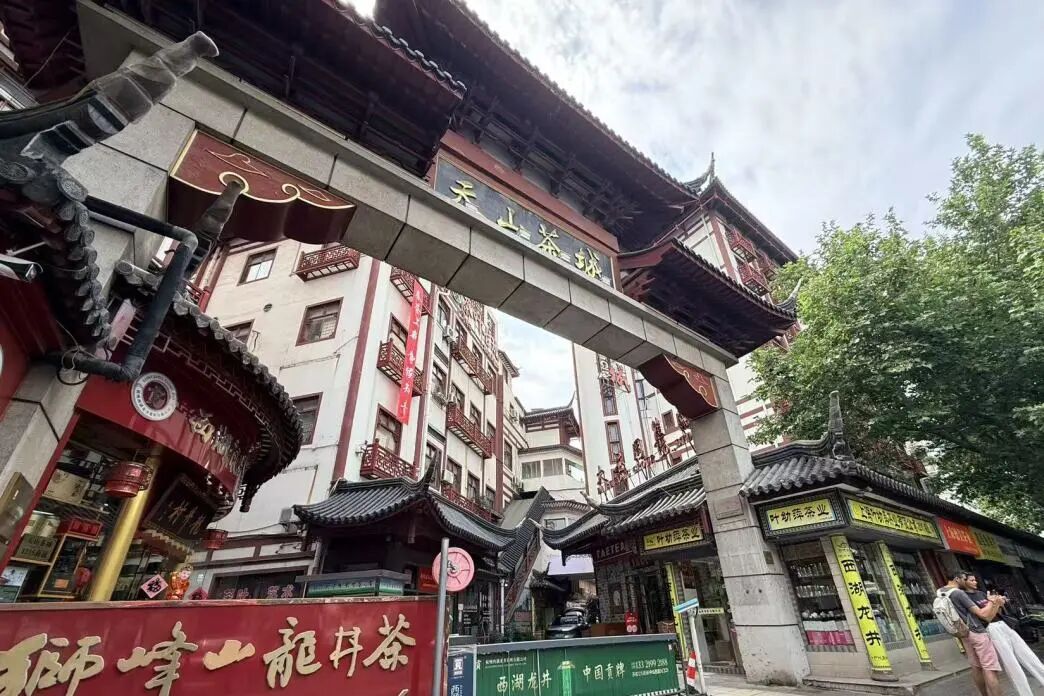
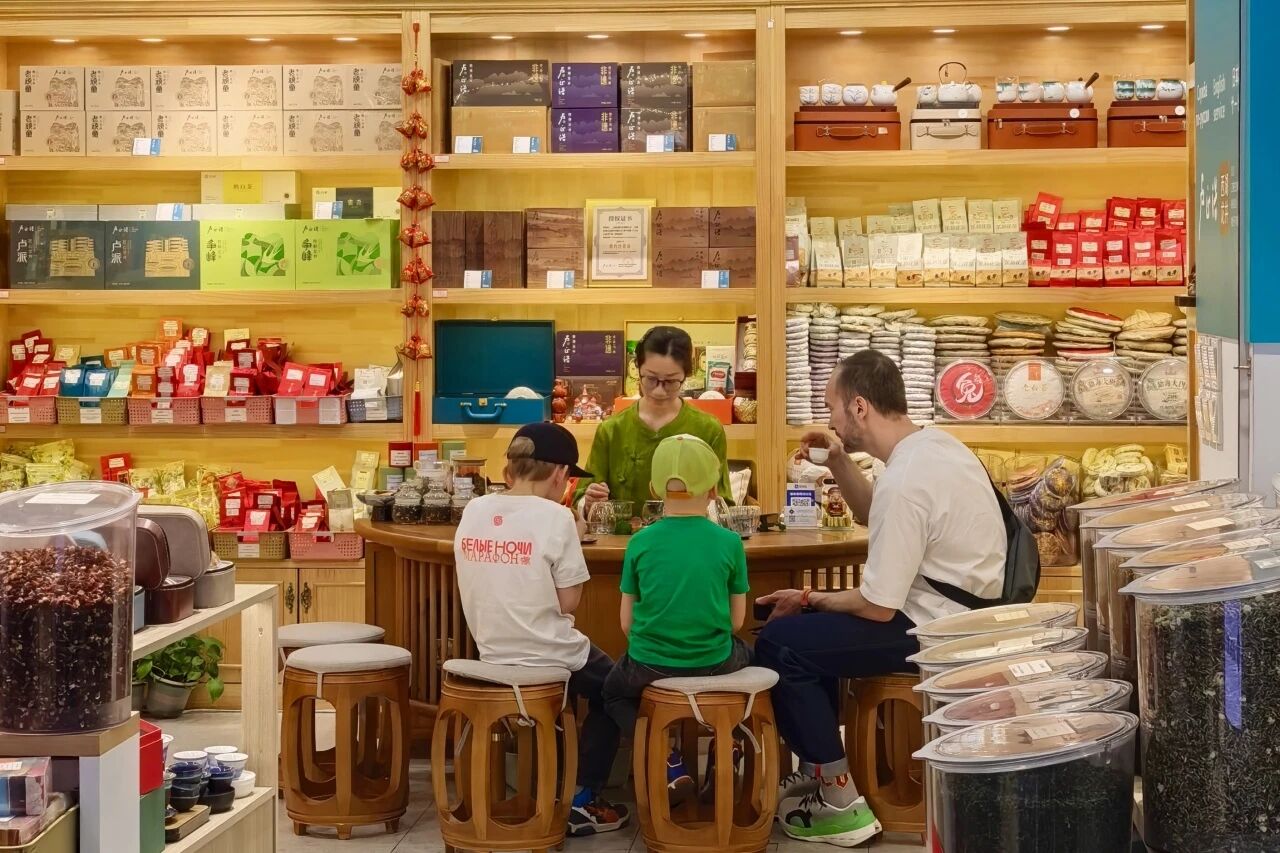
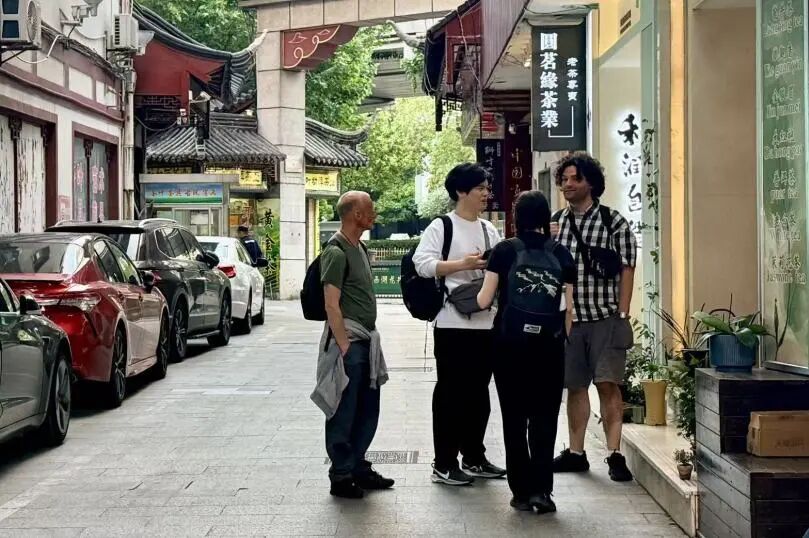
A few days ago, our reporter visited Tianshan Tea City at 520 West Zhongshan Road. When you step inside, the air was filled with the refreshing aroma of tea, accompanied by the sound of conversations in foreign languages. If you look around, many shops had foreign customers seated at their tea tables, sometimes quietly sipping tea, sometimes chatting with shop owners in simple English — experiencing Chinese culture hidden in a cup of tea.
From a beloved tea destination for local tea drinkers to a place attracting more and more foreign tourists, Tianshan Tea City has become an open and warm “international reception room.” Amid the constant flow of people, the fragrance of tea lingers, and stories keep unfolding.
Stories of searching and reunion, woven with tea aroma
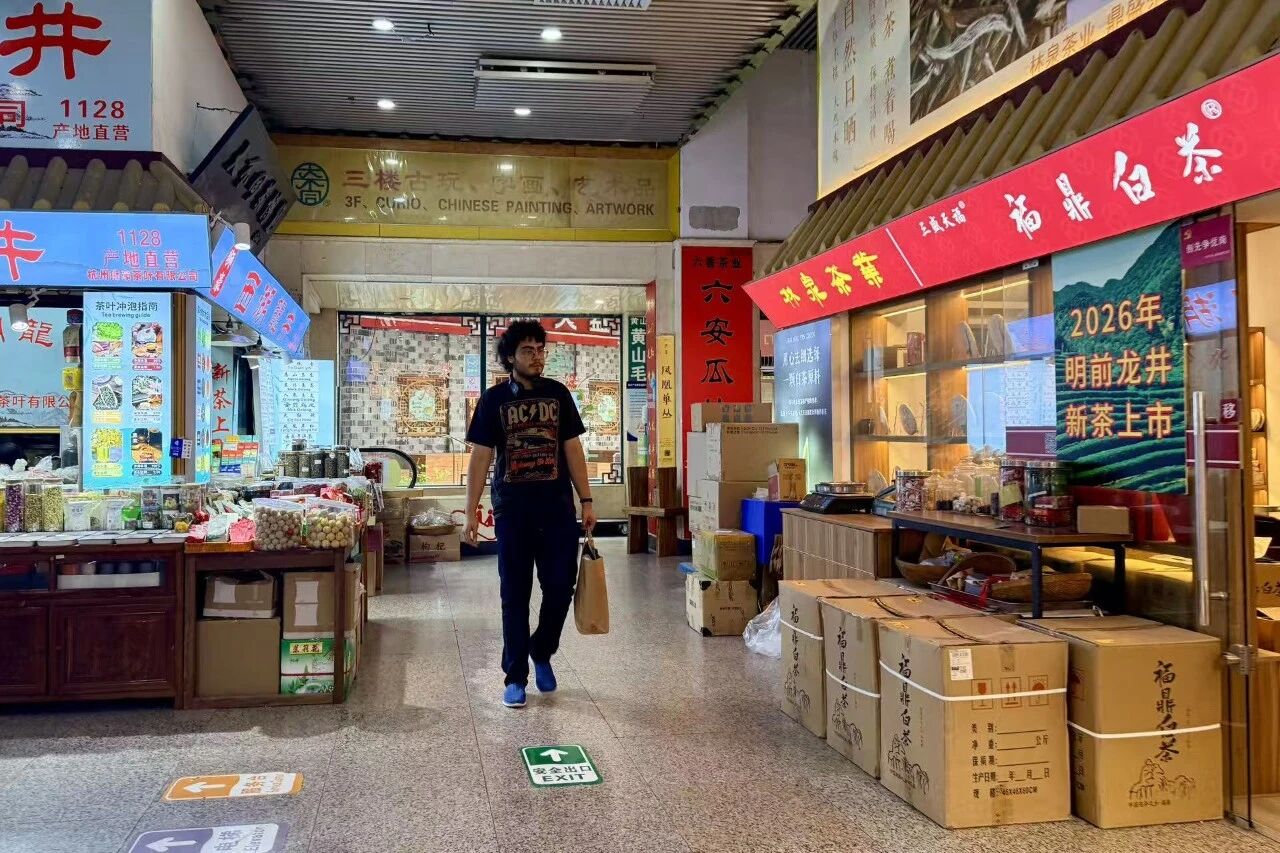
“Nihao, I wanna buy Longjing tea.” On the first floor of the tea city, a foreign tourist drew particular attention. He stopped at almost every shop, asking in simple English or via a translation app on his phone whether they had Longjing tea. Each time he received an affirmative answer, his face lit up with expectation — only to shake his head regretfully and move on to the next shop.
Approaching him, the reporter learned that the tourist was from Russia. He had learned about Tianshan Tea City from an international travel review site and came hoping to find the Longjing tea that had left an unforgettable impression on him when he first tasted it.
After walking through almost the entire floor, he returned to the “Xiancao Sanqian • Old Tea Shop,” the first shop he had visited. The owner, Ye Yuanqing, warmly invited him to sit down and savor tea slowly.
“Buying tea isn’t just about looking at the color or smelling the leaves. You have to taste it to know if it’s the one you like,” Ye said as she took out a foil bag from a refrigerator, grabbed a small amount of tea leaves and placed them into a covered teacup. After she pour in hot water, the leaves slowly unfurled in the water, the tea soup took on a bright, tender green color, and a delicate, sweet fragrance filled the air.
Ye poured the tea into the tasting cup in front of the Russian visitor. He picked up the cup, first brought it close to his nose to smell, then took a careful sip. After a moment of reflection, a smile spread across his face. He typed on his translation app: “I think I’ve found it.”
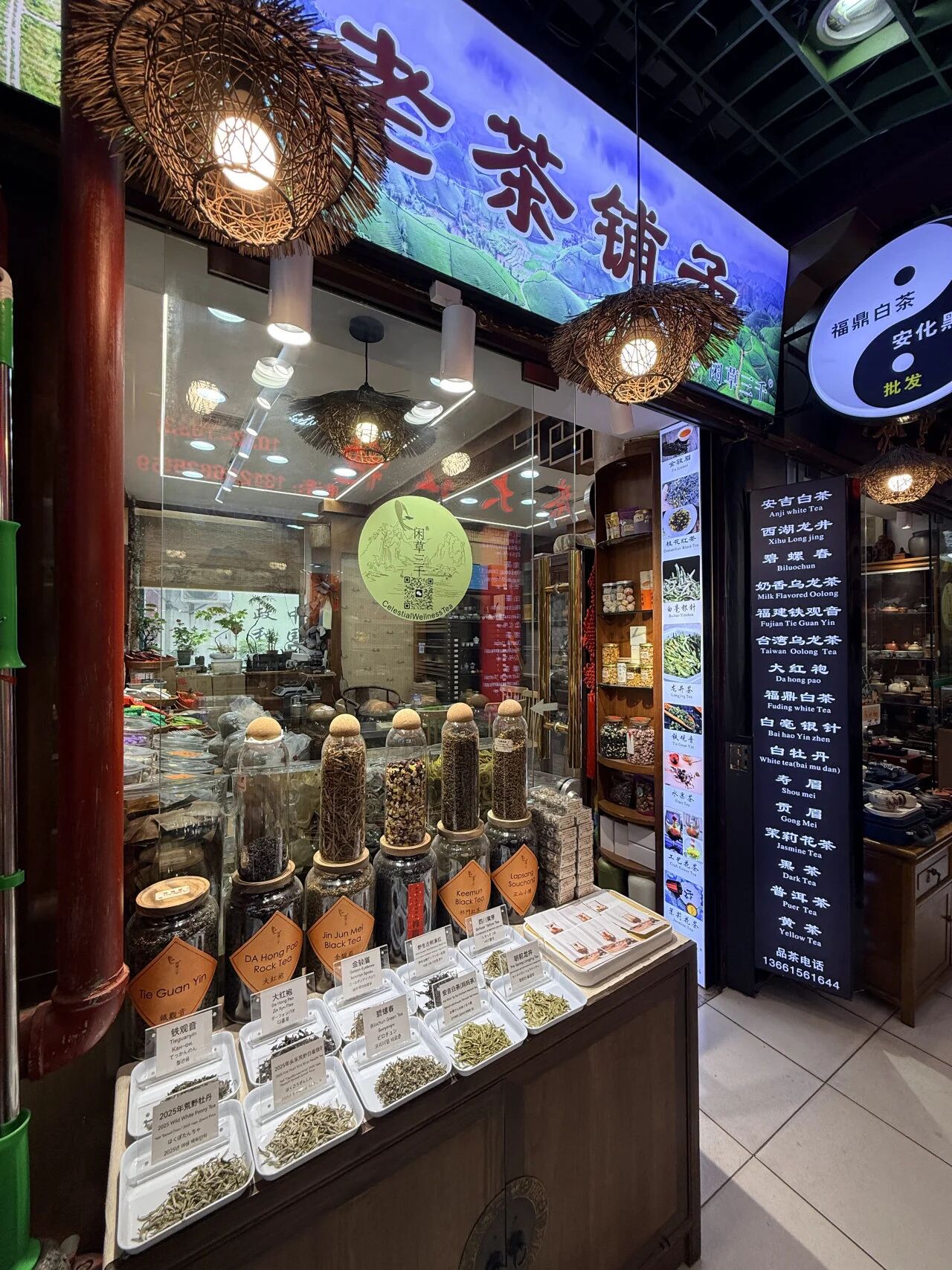
Ye told him that this was this year’s early-harvest West Lake Longjing, picked before the Qingming festival, and praised him with a smile for “understanding tea.” She then invited him to try her shop’s special Anji white tea and Silver Needle tea. Using their translation apps, the two chanted sentence by sentence, talking about the history and culture of tea, as well as the types, origins, processing methods and flavors. In the end, the Russian visitor not only found the Longjing he had been dreaming of, but also bought white tea as a gift.
Besides “new tea friends” like the Russian tourist, Ye also recently reunited with a Canadian “old tea friend” from 15 years ago.
That old tea friend is Jomanson, a customer Ye had served back then. At the time, Jomanson was studying in Shanghai. He wandered into the tea city and came to her shop. Although they couldn’t communicate fluently, they drank tea and chatted for a long time. They parted ways without exchanging contact information. Just a few days ago, when Jomanson returned to Shanghai, he made a special trip to find Ye. Ye stared at him outside the shop for a long time before recognizing him. The two sat down again, drinking tea and chatting as they did in the old days, marveling at the bond that began with tea and crossed the ocean.
Buying tea with matching teaware is becoming the norm for foreign visitors
Foreign tourists at Tianshan Tea City come in all types, and the stories that unfold over tea vary widely. But there is one striking consistency: most foreign tourists, after buying tea, head upstairs to the second floor to pick out a delicate tea set.
Longhao Teaware, one of the largest and most comprehensive teaware shops in Tianshan Tea City, has naturally become a must-visit stop for foreign customers.
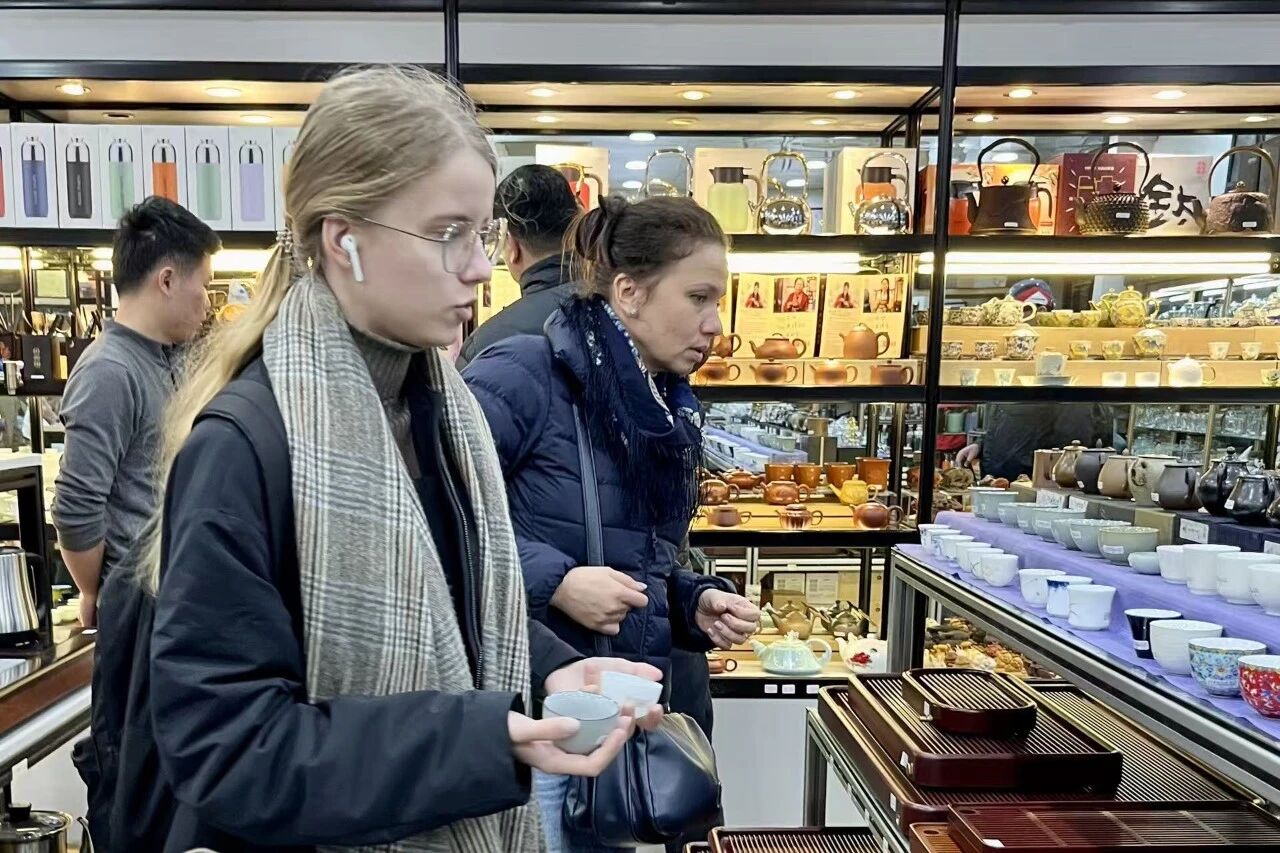
“Many foreign tourists come to choose teaware carrying the tea they just bought,” said Ni Aizhen, head of Longhao Teaware. According to her, the number of foreign customers has increased noticeably recently. Their preferences for teaware fall into roughly two categories: some prefer convenient, simple options, such as portable travel tea sets, or purchase just a covered teacup and tasting cups individually. Others like complete, all-in-one sets. Having tasted tea in the tea city, most of them are very interested in the process of gongfu tea brewing and choose to buy full gongfu tea sets with a strong sense of ritual.
Considering that many foreign customers don’t know how to use or care for their teaware after purchase, the shop provides timely explanations at the time of sale, reminding them to refer to the instructions before use, and briefly explaining methods like “initial cleaning of a new teapot” and routine cleaning precautions.
Such comprehensive and meticulous service has become the norm across various shops. Today, Tianshan Tea City is greeting tea lovers from around the world with a more open attitude.
Multilingual signs make communication smoother and service more thoughtful
Our reporter found that many shops in the tea city have put up multilingual signs and tea labels. Whether it’s the type of tea or its origin, foreign visitors can see and understand the information at a glance.
Zhang Hong, head of Jiqing Tea, one of the first shops to set up multilingual signage, told reporters that since putting up signs in Chinese-English, Chinese-Russian and other languages, the number of foreign customers coming in to ask has increased significantly. “They can see at a glance what tea I sell here, without hesitating at the door not knowing how to start a conversation.” According to her, each tea variety in the shop also has a corresponding multilingual label, allowing foreign customers to get basic information before asking further questions.
Zhang said that in the past, communicating with customers from non-English speaking countries relied entirely on gestures, sometimes leaving both sides frustrated after a long time of pointing. Now, with multilingual labels in English, Russian, Japanese, Korean and more, customers know what tea it is at a glance, saving a lot of effort and making reception much easier.
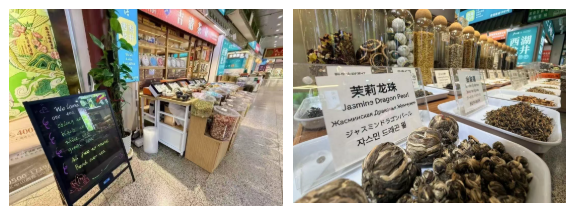
On site, a Russian customer who was picking out tea pointed to the Russian word “зелёный чай” (green tea) on a label while talking to a companion, and then walked straight into the shop to buy tea.
In addition to adding multilingual signs, shop owners have also started learning basic foreign languages and have installed translation apps on their phones. The language barrier is thus smoothed over by their thoughtfulness and care, and cultural transmission seeps into the heart cup by cup.
Service upgrades to make tea culture more ‘international’
Tianshan Tea City opened in 2002. To date, it has more than 400 shops, with an occupancy rate of over 98%. Its business scope covers tea, teaware, antiques, calligraphy and paintings, and tea culture promotion. The first floor mainly sells tea, the second floor focuses on teaware, and the third floor brings together tea-related antiques, calligraphy and paintings. After more than 20 years in operation, Tianshan Tea City, with its unique architectural style and strong tea culture atmosphere, has been reported on by dozens of domestic and international media outlets and has been approved by the Shanghai Tourism Industry Association as a “Recommended Unit for Receiving Tourist Groups.”
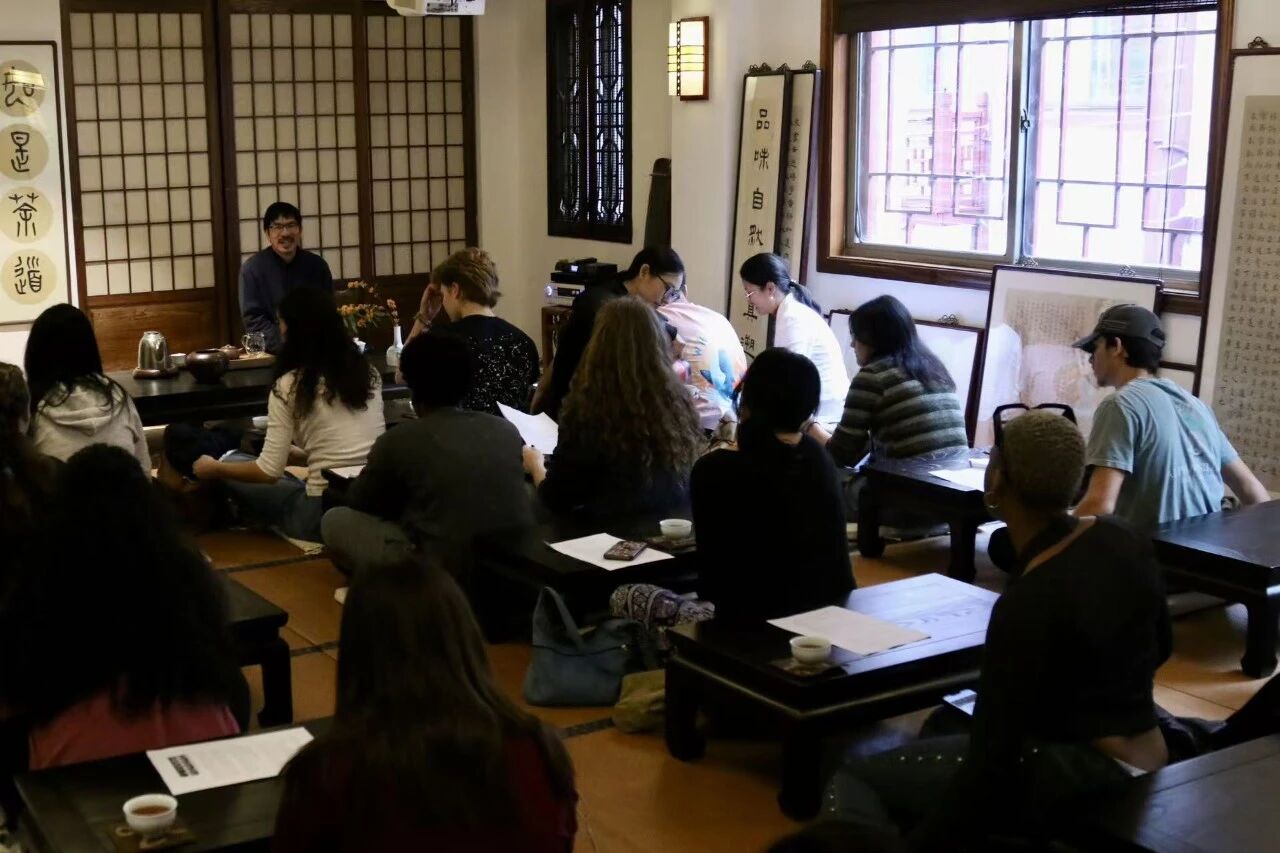
Facing the growing number of foreign tourists, Tianshan Tea City said it will actively roll out a series of service upgrade measures. “Next, we will organize merchants who are willing to participate in training for less-commonly taught languages, such as basic Russian and Japanese reception phrases, so that merchants can better communicate with customers,” said Yu Ping, head of the marketing department at Tianshan Tea City. According to Yu, many merchants have already signed up voluntarily, showing great enthusiasm.
Besides language training, the tea city also plans to launch tea culture experience activities for foreign tourists. For example, in collaboration with shops such as Pin Zhen Tang Puer Tea Club, it will regularly hold tea ceremony performances exclusively for foreign visitors, with professional tea masters demonstrating brewing methods using covered teacups and purple clay pots for different types of tea, or set up tasting classes so that visitors can sample teas from different regions under professional guidance and learn to distinguish tea by color, aroma, taste and shape.
“We hope that through these activities, tourists can not only ‘buy tea’ but also ‘understand tea,’” Yu said. Leveraging the wave of inbound tourism, the tea city aims to become a showcase window for foreign tourists to learn about Chinese tea culture.
Tea aroma knows no borders. From foreign tea lovers coming by choice and leaving satisfied, to merchants putting up new signs and installing translation apps to share Chinese tea culture, Tianshan Tea City is welcoming tea enthusiasts from all over the world with a simple cup of tea.